Duration 1 month approx.
These courses are being updated with artificial intelligence. We try to stay at the front of what AI can do: the tools change, and the syllabus is revised so that what you learn still holds when you publish.
Added to the cart. See the final price.
Ancla teaches you to build a website of your own, from the first decision to the moment it is online, for a business that needs a clear page someone else can understand. It is not an advanced programming course. It is the craft of choosing which pages are needed, what they are called, what goes on each one and how the site is put on the internet. The starting point is a real business: a workshop, a rental, a practice or a shop. The site is built from that offer, not the other way round.
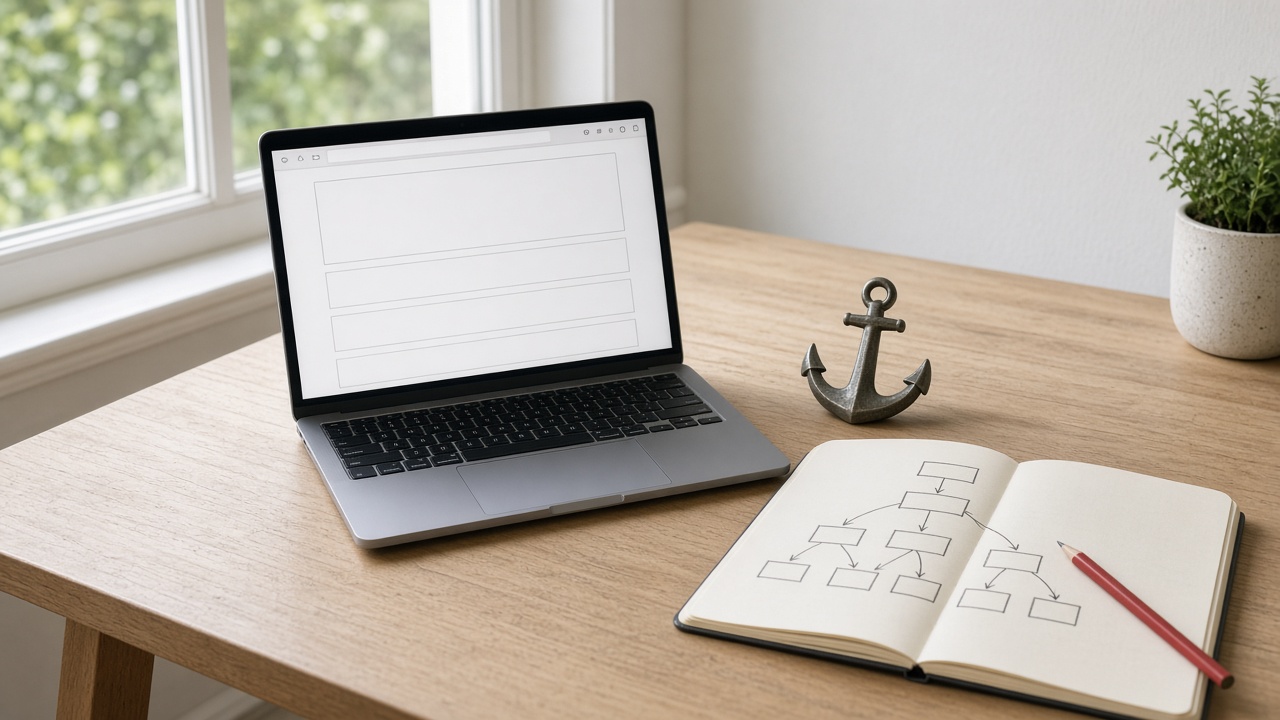
It starts with the site map. A small business does not need twenty pages. It needs a home page that says what is offered, a services page, a contact page and, if the work can be shown, an examples page. You learn to name those pages with words a person would use, not internal labels. The address, the title in the browser tab and the main heading have to say the same thing. That repetition, done carefully, is what makes the site understandable and what later makes it possible to rank. You also decide what stays out: empty pages, blogs with no update date, and sections that exist only because a template included them.
Then you work with HTML that means something. A title is an h1, and there is one per page. A subtitle is an h2. A paragraph is a paragraph. A button is a real link or button, not a picture with words on it. You see the difference between a div that only decorates and a tag that describes the content: header, nav, main, section, article and footer. That choice matters for a screen reader, for a phone layout and for a search engine trying to tell what the page is about. You practise reading the code aloud: if the tag does not describe what is inside, you change it. Image alternative text cannot be “photo1”. It has to say what is shown and why it is on that page.
Content is organised in blocks. Each block has one idea, a heading and the text that supports it. You practise cutting what does not help: empty slogans, lists of adjectives, paragraphs that repeat the same fact. You write the offer, the place, the hours if they exist and the way to get in touch. You separate copy that guides a visitor from copy that only decorates. A paragraph that answers no concrete question is rewritten or removed. The student pays for the domain and the hosting. The course explains what each one is, how a domain points at a host and how files are uploaded, without selling a closed package or hiding where a form goes.
Publishing covers the minimum so the site is not born broken. Links go where they say they go. The form has the fields it needs and does not ask for more. The contact page works on a phone. Images are not so heavy that the page waits. You learn how to name files, how to keep folders in order and how not to overwrite a good version with an experiment. You check the page title, the description and the address before calling the site done. A broken link, a missing image or a form that never confirms the message are fixed in the course, not left for later. A week produces a short site with the base pages and publishable text. Fifteen days add a second language or another page, with more time to correct. A month lets the site grow: more pages, more review and a structure that can carry the SEO work of the other courses. Ancla does not replace a developer when the project needs an application, a complex shop or a custom integration. It lets you build and publish a simple site, understand the code that holds it and stop depending on a template you cannot change.
 Español
 English